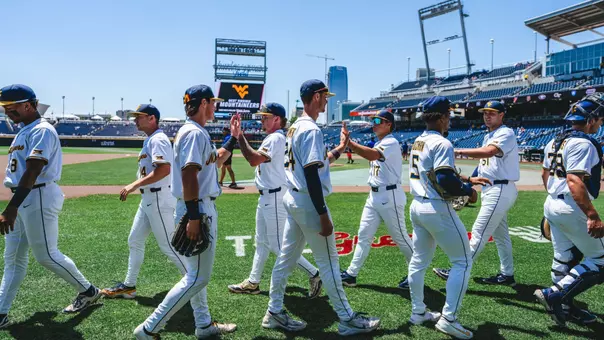
Photo by: WVU Athletic Communications
Luck’s Vision Becoming a Reality
June 08, 2026 02:00 PM | Baseball
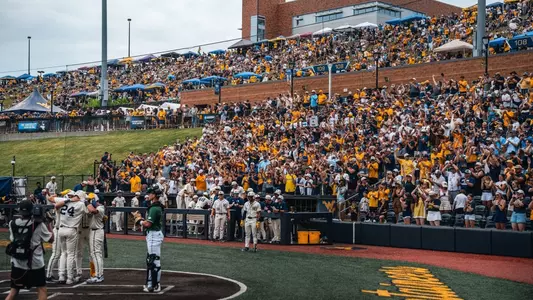
MORGANTOWN, W.Va. – When Bridgeport's Ben McDougal registered the final out of West Virginia's Super Regional-clinching 17-1 victory over Cal Poly at Kendrick Family Ballpark on Saturday afternoon, there was one man in Colorado sitting in front of his flat-screen television with a mile-high smile on his face.
That man was Oliver Luck - the person responsible for putting Mountaineer baseball in the position it is in today. He's the one who assembled the group of people for a meeting in room 294 in the WVU Coliseum on Wednesday, Nov. 16, 2011, to map out the program's future. More on that meeting in a moment.
 Luck, West Virginia University's director of athletics from 2010-14, was also the person responsible for orchestrating the school's move from the Big East to the Big 12 Conference because, in Luck's words, "the Big East left us."
The two Big East schools West Virginia was most closely aligned with at the time – Pitt and Syracuse – announced during the fall of 2011 their desire to join the Atlantic Coast Conference, prompting everyone else to go into scramble mode.
It was at that moment Luck understood that the Big East was no longer a viable all-sports conference.
"(Joining the Big 12 Conference) was my No. 1, No. 2, No. 3 and No. 4 focus," he recalled Sunday afternoon.
When that was finally accomplished on July 1, 2012, there were other pressing issues, one of them being what to do with a baseball program that was in a purgatory state because of a lack of funding and support.
Luck, who played football for the Mountaineers and later attended law school at the University of Texas, became familiar with the deep history and tradition of Longhorn baseball; he knew his alma mater's baseball team was entering the deep end of the pool without a life preserver. Despite some modest investments through the years, WVU's home facility, Hawley Field, was not adequate for Big 12 baseball, and the scholarship support was not conducive to having a roster of players capable of competing with the top teams in the league.
In fact, at the time, baseball had less scholarship dollars at its disposal than top Big East teams Notre Dame, Rutgers, St. John's and Connecticut, which basically equated to one less starting pitcher or a couple of quality position players on its roster each season.
Luck knew he had a difficult course to chart, and he needed lots of help. He called his friend Ken Kendrick, owner of the Arizona Diamondbacks, for some advice. He also reached out to Pittsburgh Pirates owner Bob Nutting, and both offered to lend him some of their top personnel people.
Luck organized what was to be called West Virginia University's "Baseball Summit," and the participants he summoned ran the gamut of college and professional sports.
Graham Rossini, now director of athletics at Arizona State, came from the Diamondbacks organization. Kyle Stark, then the Pirates' assistant general manager for player development, came down to Morgantown from Pittsburgh.
Luck asked Buckhannon native Chris Wallace, general manager of the NBA's Memphis Grizzlies and the son of former Mountaineer baseball player Bobby Wallace, to offer his knowledge on player development, even though his expertise was in college and professional basketball.
"I was thrilled to participate, even without significant knowledge of college baseball," Wallace, now director of scouting for the Houston Rockets, recalled. "I didn't even know how they divided up scholarships, so it was a real eye-opening experience for me."
Luck asked professional colleague David Johnston, then-owner of Rockbridge Sports and formerly of CBS Sports, to offer his insights on media rights and the overall financial potential of college baseball, and he also invited alum and Mountaineer Athletic Club member Stu Robbins to provide a business perspective.
WVU geology professor and Athletic Council member Steve Kite was asked to participate for his counsel and wisdom, and also because Luck knew that he was eventually going to need an advocate on the Athletic Council for whatever decisions were made.
He invited former WVU baseball players Jedd Gyorko and David Carptener, both playing in the Major Leagues at the time, to share their experiences playing for the Mountaineers and some of the challenges that they had to overcome during their collegiate careers.
The final participant was the most interesting, and perhaps the most controversial – former Major League catcher Steve Swisher, who had zero ties to West Virginia University. Swisher grew up in Parkersburg, played against WVU when he attended Ohio University, and spent nine seasons in the Majors with the Chicago White Sox, St. Louis Cardinals and San Diego Padres before serving several years as a minor league manager.
Swisher's son Nick played college baseball at Ohio State and later professionally for the New York Yankees, so Luck wanted to get an unfiltered view of West Virginia's recruiting challenges and the program's overall perception within the state.
"Of all of the participants, Steve was the bluntest," Luck recalled, laughing.
The discussions that took place that day gave him a much clearer idea of what he was going to do. Keli Zinn, today director of athletics at Rutgers, remembered those meetings that afternoon coming down to being an "all-in" or "drop the program" choice.
"It's just incredible what has happened since then," she said.
Wallace remembers the topic of dropping baseball coming up at one point and him sitting uncomfortably in his chair listening to it. His father was the Southern Conference batting champ in 1951 and has long supported the Mountaineers. Today, the nurses at the assisted care facility where he's living in Harrisonburg, Virginia, are required to put WVU games on his TV whenever they are playing.
"I'm thinking to myself, based on the resources they had at the time, how in the hell can they ever be competitive?" Wallace said. "Baseball here was so hand-to-mouth – no lockers, the coaches doing their own grounds work. I was amazed at what the other programs had to spend in comparison to West Virginia, not to mention the weather challenges. It was just hurdle after hurdle."
But Wallace also knew it would break his father's heart if the decision was made to drop baseball, and he found out that his son was a part of it.
"My old man would have had a coronary if that happened," he said.
Luck understood what dropping baseball would have meant to the people of West Virginia, too, so he purposely stacked the deck with pro-baseball people willing to offer creative solutions to the problems that were in front of him.
It was Stark who was adamant that an artificial surface be installed to be able to play games in March when the weather in Morgantown can be so unpredictable. And it was Rossini who told Luck that he needed someone with a strong developmental background to oversee the program.
As Luck remembers it, Rossini said prospects living near Morgantown in the Northeast required more developing and seasoning than those living in the southern part of the country because they didn't play as many games and often participated in other sports.
"They were just as good; it just took them a little bit longer to get there," Luck observed.
Talk about a self-fulfilling prophecy: West Virginia's two best recent players – JJ Wetherholt and Gavin Kelly – hail from the Pittsburgh area. Wetherholt was the seventh player taken in the Major League Draft two years ago and is a leading candidate for Rookie of the Year honors playing for the St. Louis Cardinals, while some are projecting Kelly as the potential No. 1 overall pick in 2027!
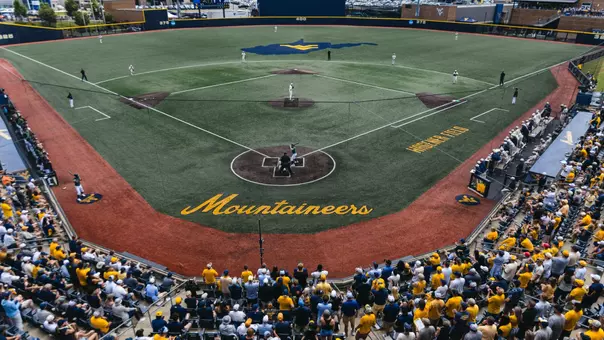
Beyond those things, everyone involved agreed on one thing – a new ballpark was required.
"Getting a new ballpark was a whole different component and a story in itself," Luck said. "(Then-West Virginia University president) Jim Clements was supportive, but he told me I was going to have to find the money to do it because the University couldn't afford it."
That's where Luck's vast experience working for the Houston Sports Authority getting the city's three major sports venues constructed became invaluable.
"I understand TIFs (tax increment financing) and all of the issues involved with them," he explained. "I needed to find $25 million and lots of allies."
He had one in then-Governor Earl Ray Tomblin, provided Luck could identify a professional team to play in a new baseball facility during the summer. A TIF financing a facility just for college baseball would have been tough for citizens to support, especially for a baseball program that had not made an NCAA Tournament appearance since 1996.
Luck's other big ally was Kendrick, particularly when local editorials questioning the wisdom of supporting a TIF for a baseball stadium were being published.
"I talked to Ken all the time. He was always my first phone call," Luck explained. "He was such a great help because he also had a lot of experience and knowledge in the TIF process."
Eventually, a professional tenant was identified when the Pirates acquired the Jamestown Jammers of the New York-Penn League. The Jammers were seeking a new facility, and the local politicians eventually got on board when the decision to vote on appropriating the TIF was extended into a special session.
Completing the process was the hiring of longtime coach Randy Mazey, which led to the hiring of Steve Sabins two years ago.
Mazey led West Virginia to the Super Regionals in 2023, and Sabins has topped that with another and now a College World Series berth this year – the first in school history. Baseball is the second oldest sport at West Virginia University, just one year younger than Mountaineer football, which began in 1891.
That's a long, long time.
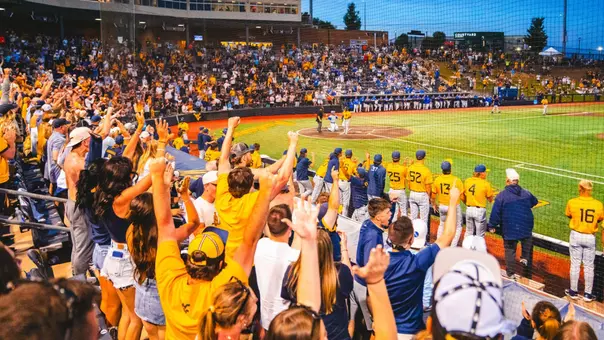
"Watching them from afar, I'm just blown away by the success they've had this year," Wallace said. "Seeing a stadium full of people singing '(Take Me Home) Country Roads' on NBC's Nightly News, are you kidding me?
"That's free advertising for West Virginia University," he added.
"I'm so proud of everyone," Luck, now a member of West Virginia University's Board of Governors, added. "There were so many people involved in this process through the years. Who would have thought that Armani Guzman, from New York City, would ever be popular enough here to run for mayor of Morgantown?"
"I'd say that anything is possible if there is belief, backing and support," Sabins said following his team's victory over Cal Poly this past weekend. "If you get the right people in the room, and the right relationships are connected, anything is possible."
The first step in West Virginia's journey to Omaha was taken that mid-November day in 2011. The participants involved came there willing to either offer positive ideas and solutions, or penetrating, practical suggestions.
Luck, the person organizing the meeting, was willing to stick his neck out to make it become a reality.
"We didn't do it because, all of a sudden, we miraculously have the most talented 40 players on our roster; we have really good players and a lot of talent – but there's something more to it than that," Sabins explained. "There is culture. There is work and there is belief, and what this team has done is it has outworked people for the last decade, and now you are starting to see some of the fruits of that labor show up."
Luck always sensed that Mountaineer fans would be willing to support college baseball in the springtime when the weather here was better. What else was there to do athletically related in Morgantown until August after spring football practice? He thought people would like to sit outside, perhaps sip a brew or two, and watch some college baseball in a brand new ballpark.
He was right.
The letter B seems to sum up Luck's four-year tenure here as West Virginia University's director of athletics.
B - for the Big 12 Conference, which Luck championed when many others were skeptical of leaving the school's traditional ties to the Northeast.
B - for beer, which Luck advocated selling at athletic events as a means for generating additional revenue. Now, every school in the country is selling it, including many of the Christian schools.
B – for ballpark, which Luck managed to successfully steer through the West Virginia Legislature.
And B - for baseball, which Oliver Luck was responsible for reinventing at West Virginia University when he brought together an eclectic blend of professionals to help him chart a course for the future.
"I remember emailing Oliver afterward, 'You have to be all-in or don't play at all,'" Wallace said.
"Looks like the right decision was made," Zinn concluded.
Indeed, it was.
Enjoy the team's success, Mountaineer fans, and now it's on to Omaha!
That man was Oliver Luck - the person responsible for putting Mountaineer baseball in the position it is in today. He's the one who assembled the group of people for a meeting in room 294 in the WVU Coliseum on Wednesday, Nov. 16, 2011, to map out the program's future. More on that meeting in a moment.
Luck, West Virginia University's director of athletics from 2010-14, was also the person responsible for orchestrating the school's move from the Big East to the Big 12 Conference because, in Luck's words, "the Big East left us."The two Big East schools West Virginia was most closely aligned with at the time – Pitt and Syracuse – announced during the fall of 2011 their desire to join the Atlantic Coast Conference, prompting everyone else to go into scramble mode.
It was at that moment Luck understood that the Big East was no longer a viable all-sports conference.
"(Joining the Big 12 Conference) was my No. 1, No. 2, No. 3 and No. 4 focus," he recalled Sunday afternoon.
When that was finally accomplished on July 1, 2012, there were other pressing issues, one of them being what to do with a baseball program that was in a purgatory state because of a lack of funding and support.
Luck, who played football for the Mountaineers and later attended law school at the University of Texas, became familiar with the deep history and tradition of Longhorn baseball; he knew his alma mater's baseball team was entering the deep end of the pool without a life preserver. Despite some modest investments through the years, WVU's home facility, Hawley Field, was not adequate for Big 12 baseball, and the scholarship support was not conducive to having a roster of players capable of competing with the top teams in the league.
In fact, at the time, baseball had less scholarship dollars at its disposal than top Big East teams Notre Dame, Rutgers, St. John's and Connecticut, which basically equated to one less starting pitcher or a couple of quality position players on its roster each season.
Luck knew he had a difficult course to chart, and he needed lots of help. He called his friend Ken Kendrick, owner of the Arizona Diamondbacks, for some advice. He also reached out to Pittsburgh Pirates owner Bob Nutting, and both offered to lend him some of their top personnel people.
Luck organized what was to be called West Virginia University's "Baseball Summit," and the participants he summoned ran the gamut of college and professional sports.
Graham Rossini, now director of athletics at Arizona State, came from the Diamondbacks organization. Kyle Stark, then the Pirates' assistant general manager for player development, came down to Morgantown from Pittsburgh.
Luck asked Buckhannon native Chris Wallace, general manager of the NBA's Memphis Grizzlies and the son of former Mountaineer baseball player Bobby Wallace, to offer his knowledge on player development, even though his expertise was in college and professional basketball.
"I was thrilled to participate, even without significant knowledge of college baseball," Wallace, now director of scouting for the Houston Rockets, recalled. "I didn't even know how they divided up scholarships, so it was a real eye-opening experience for me."
Luck asked professional colleague David Johnston, then-owner of Rockbridge Sports and formerly of CBS Sports, to offer his insights on media rights and the overall financial potential of college baseball, and he also invited alum and Mountaineer Athletic Club member Stu Robbins to provide a business perspective.
WVU geology professor and Athletic Council member Steve Kite was asked to participate for his counsel and wisdom, and also because Luck knew that he was eventually going to need an advocate on the Athletic Council for whatever decisions were made.
He invited former WVU baseball players Jedd Gyorko and David Carptener, both playing in the Major Leagues at the time, to share their experiences playing for the Mountaineers and some of the challenges that they had to overcome during their collegiate careers.
The final participant was the most interesting, and perhaps the most controversial – former Major League catcher Steve Swisher, who had zero ties to West Virginia University. Swisher grew up in Parkersburg, played against WVU when he attended Ohio University, and spent nine seasons in the Majors with the Chicago White Sox, St. Louis Cardinals and San Diego Padres before serving several years as a minor league manager.
Swisher's son Nick played college baseball at Ohio State and later professionally for the New York Yankees, so Luck wanted to get an unfiltered view of West Virginia's recruiting challenges and the program's overall perception within the state.
"Of all of the participants, Steve was the bluntest," Luck recalled, laughing.
The discussions that took place that day gave him a much clearer idea of what he was going to do. Keli Zinn, today director of athletics at Rutgers, remembered those meetings that afternoon coming down to being an "all-in" or "drop the program" choice.
"It's just incredible what has happened since then," she said.
Wallace remembers the topic of dropping baseball coming up at one point and him sitting uncomfortably in his chair listening to it. His father was the Southern Conference batting champ in 1951 and has long supported the Mountaineers. Today, the nurses at the assisted care facility where he's living in Harrisonburg, Virginia, are required to put WVU games on his TV whenever they are playing.
"I'm thinking to myself, based on the resources they had at the time, how in the hell can they ever be competitive?" Wallace said. "Baseball here was so hand-to-mouth – no lockers, the coaches doing their own grounds work. I was amazed at what the other programs had to spend in comparison to West Virginia, not to mention the weather challenges. It was just hurdle after hurdle."
But Wallace also knew it would break his father's heart if the decision was made to drop baseball, and he found out that his son was a part of it.
"My old man would have had a coronary if that happened," he said.
Luck understood what dropping baseball would have meant to the people of West Virginia, too, so he purposely stacked the deck with pro-baseball people willing to offer creative solutions to the problems that were in front of him.
It was Stark who was adamant that an artificial surface be installed to be able to play games in March when the weather in Morgantown can be so unpredictable. And it was Rossini who told Luck that he needed someone with a strong developmental background to oversee the program.
As Luck remembers it, Rossini said prospects living near Morgantown in the Northeast required more developing and seasoning than those living in the southern part of the country because they didn't play as many games and often participated in other sports.
"They were just as good; it just took them a little bit longer to get there," Luck observed.
Talk about a self-fulfilling prophecy: West Virginia's two best recent players – JJ Wetherholt and Gavin Kelly – hail from the Pittsburgh area. Wetherholt was the seventh player taken in the Major League Draft two years ago and is a leading candidate for Rookie of the Year honors playing for the St. Louis Cardinals, while some are projecting Kelly as the potential No. 1 overall pick in 2027!
Beyond those things, everyone involved agreed on one thing – a new ballpark was required.
"Getting a new ballpark was a whole different component and a story in itself," Luck said. "(Then-West Virginia University president) Jim Clements was supportive, but he told me I was going to have to find the money to do it because the University couldn't afford it."
That's where Luck's vast experience working for the Houston Sports Authority getting the city's three major sports venues constructed became invaluable.
"I understand TIFs (tax increment financing) and all of the issues involved with them," he explained. "I needed to find $25 million and lots of allies."
He had one in then-Governor Earl Ray Tomblin, provided Luck could identify a professional team to play in a new baseball facility during the summer. A TIF financing a facility just for college baseball would have been tough for citizens to support, especially for a baseball program that had not made an NCAA Tournament appearance since 1996.
Luck's other big ally was Kendrick, particularly when local editorials questioning the wisdom of supporting a TIF for a baseball stadium were being published.
"I talked to Ken all the time. He was always my first phone call," Luck explained. "He was such a great help because he also had a lot of experience and knowledge in the TIF process."
Eventually, a professional tenant was identified when the Pirates acquired the Jamestown Jammers of the New York-Penn League. The Jammers were seeking a new facility, and the local politicians eventually got on board when the decision to vote on appropriating the TIF was extended into a special session.
Completing the process was the hiring of longtime coach Randy Mazey, which led to the hiring of Steve Sabins two years ago.
Mazey led West Virginia to the Super Regionals in 2023, and Sabins has topped that with another and now a College World Series berth this year – the first in school history. Baseball is the second oldest sport at West Virginia University, just one year younger than Mountaineer football, which began in 1891.
That's a long, long time.
"Watching them from afar, I'm just blown away by the success they've had this year," Wallace said. "Seeing a stadium full of people singing '(Take Me Home) Country Roads' on NBC's Nightly News, are you kidding me?
"That's free advertising for West Virginia University," he added.
"I'm so proud of everyone," Luck, now a member of West Virginia University's Board of Governors, added. "There were so many people involved in this process through the years. Who would have thought that Armani Guzman, from New York City, would ever be popular enough here to run for mayor of Morgantown?"
"I'd say that anything is possible if there is belief, backing and support," Sabins said following his team's victory over Cal Poly this past weekend. "If you get the right people in the room, and the right relationships are connected, anything is possible."
The first step in West Virginia's journey to Omaha was taken that mid-November day in 2011. The participants involved came there willing to either offer positive ideas and solutions, or penetrating, practical suggestions.
Luck, the person organizing the meeting, was willing to stick his neck out to make it become a reality.
"We didn't do it because, all of a sudden, we miraculously have the most talented 40 players on our roster; we have really good players and a lot of talent – but there's something more to it than that," Sabins explained. "There is culture. There is work and there is belief, and what this team has done is it has outworked people for the last decade, and now you are starting to see some of the fruits of that labor show up."
Luck always sensed that Mountaineer fans would be willing to support college baseball in the springtime when the weather here was better. What else was there to do athletically related in Morgantown until August after spring football practice? He thought people would like to sit outside, perhaps sip a brew or two, and watch some college baseball in a brand new ballpark.
He was right.
The letter B seems to sum up Luck's four-year tenure here as West Virginia University's director of athletics.
B - for the Big 12 Conference, which Luck championed when many others were skeptical of leaving the school's traditional ties to the Northeast.
B - for beer, which Luck advocated selling at athletic events as a means for generating additional revenue. Now, every school in the country is selling it, including many of the Christian schools.
B – for ballpark, which Luck managed to successfully steer through the West Virginia Legislature.
And B - for baseball, which Oliver Luck was responsible for reinventing at West Virginia University when he brought together an eclectic blend of professionals to help him chart a course for the future.
"I remember emailing Oliver afterward, 'You have to be all-in or don't play at all,'" Wallace said.
"Looks like the right decision was made," Zinn concluded.
Indeed, it was.
Enjoy the team's success, Mountaineer fans, and now it's on to Omaha!
Players Mentioned


Wednesday, June 17
Tuesday, June 16
Tuesday, June 16
Tuesday, June 16