Lee Patton - WVU Sports Hall of Fame

Lee Patton
- Induction:
- 2004
- Class:
- 1950
Lee Lafayette Patton, known affectionately as Worry Bird, served WVU as head coach for men's basketball from the 1945-46 season until a Valentine's Day car crash in 1950 ultimately took his life.
Coach Patton was revered by his players, fans, students, sportswriters and colleagues. Patton teams were noted for intense man-to man-defenses, ultra-fast break offenses, mastery of fundamentals, physical and mental fitness, exceptional execution, team unity and high standards of sportsmanship.
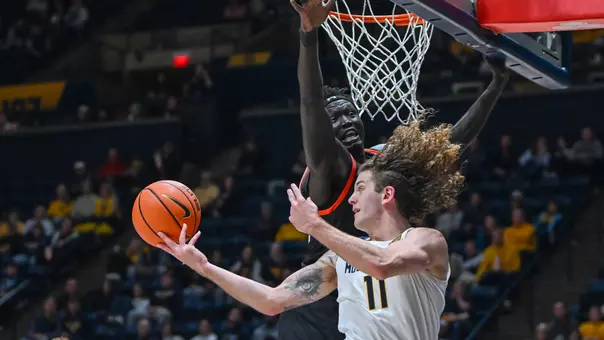
Patton elevated men's basketball at WVU to unprecedented heights, setting records that remain unbroken. His teams drew record crowds to Mountaineer Field House, which visiting teams dubbed the House of Horrors. For many years, Patton's achievements, holistic philosophy, dedication to humanics and legacy as a whole were overshadowed by his tragic death.
Coach Lee Patton was born in Carbon, Texas, and spent his early childhood in nearby railroad camps. When his parents divorced, six-year-old Lee, his sister, and his mother moved to East Dallas. The son of a single mother and a railroad laborer, he was not accorded the opportunities of those from more established, affluent families. Although excluded from school sports, Lee took advantage of YMCA programs and various sports leagues to advance his athletic ambitions. Following high school, Lee earned a scholarship and two-year degree at Sul Ross State College, where he excelled in academics, football, baseball and basketball. Lee then earned a scholarship and four-year degree at Northern Arizona State College, where he again excelled in academics and all sports.
After two years of coaching championship basketball teams at Ash Fork High School (Ariz.), Patton enrolled in the prestigious master's program at Springfield College where he studied under Knute Rockne, Phog Allen and other luminaries. Graduating with honors in Culture and Athletics, Lee rejected opportunities at some of the nation's most elite prep schools to coach at Princeton High School in southern West Virginia. Throughout the Great Depression and most of World War II (1930-44), Patton's Princeton Tigers were a dominant force in West Virginia basketball and football.
In 1944, Lee was recruited to Iona Prep in New Rochelle, New York. Following one year of unbridled success in New York, Patton was hired by Roy "Legs" Hawley, WVU Athletic Director, to serve as chief assistant football coach and head coach for men's basketball. Success was immediate and dramatic. That first year, Coach Patton launched WVU basketball's Era of Excellence - a period that began with a 24-3 season plus a trip to the NIT and extended far beyond Patton's lifetime - ultimately producing 19 consecutive winning seasons between 1945-46 and 1964-65 while racking up an accumulative win/loss record of 76.5%.
Lee Patton coached just four full seasons before his untimely death during his fifth season. In those first four seasons, his teams won 83.9% of their games - a record rarely achieved in college basketball and one that remains unbroken at WVU. Additionally, Coach Patton holds WVU's all-time men's basketball record for highest percent of home wins (95.3%), the longest streak of home wins (57), the most seasons with 85% or more wins (3), the highest percent of seasons with 85% or more wins (60%), and the most players inducted into the WVU Sports Hall of Fame (9). Ten of Patton's athletes went on to the pros. Lee's overall win/loss record of 77.8% at WVU is surpassed only by his protégé and former player Fred Schaus (79.8%)
Patton's legacy also includes three transformative WVU Athletic Directors: Red Brown (former Patton assistant coach), Leland Byrd (former Patton player), and Fred Schaus (former Patton player). Coach Patton played a crucial role in WVU's admittance into the Southern Conference and is a member of the West Virginia Sportswriters Hall of Fame, the Princeton High School Hall of Fame and the WVU Sports Hall of Fame (Class of 2004).
A biography published in 2026, Coach Lee Patton, The Untold Legend, has gained attention from teachers, coaches, student-athletes and community leaders around the country and sparked new interest in Coach Patton, his players, humanics and formative times in WVU sports history.
Friday, November 13
Friday, November 13
Thursday, November 12
Thursday, November 12